Date: 11/04/2026
KEY JUDGMENTS
KJ-1 — Systemic Transition to Narco-Fragmented Security Environment (HIGH CONFIDENCE)
Ecuador has transitioned from a transit-state narcotics corridor into a fragmented criminal governance environment, where multiple armed organizations exert localized territorial control, particularly in coastal provinces and prison systems.
KJ-2 — Violence is Structurally Embedded, Not Cyclical (HIGH CONFIDENCE)
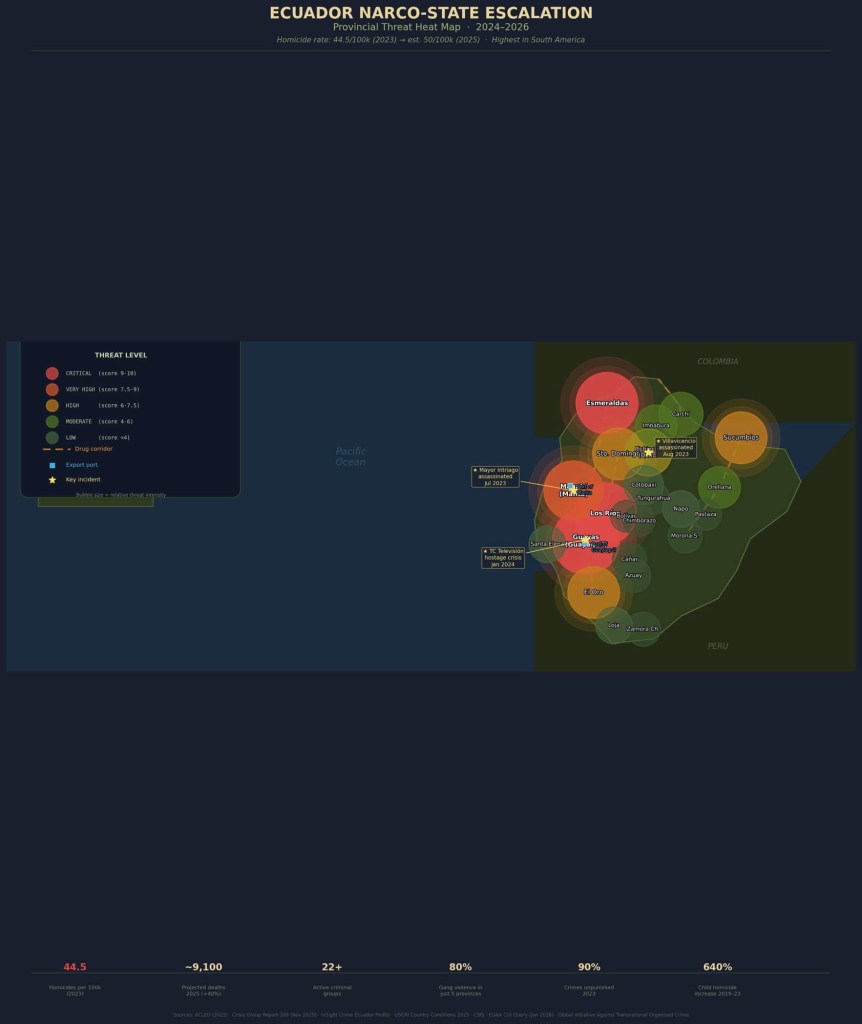
Homicide escalation (peaking above ~40 per 100,000 in 2023 and remaining at extreme levels through 2024–2026) reflects structural state erosion rather than temporary cartel conflict cycles.
KJ-3 — Cartel Ecosystem is Highly Fragmented but Hierarchically Connected (MEDIUM–HIGH CONFIDENCE)
Major organizations maintain fluid alliances with transnational cartels (notably Mexican networks) while simultaneously engaging in intra-national fragmentation and prison-based command structures.
KJ-4 — Foreign Security Involvement Has Shifted from Advisory to Kinetic (MEDIUM CONFIDENCE)
U.S. engagement has progressed from advisory/JCET frameworks to reported direct operational involvement in counter-narcotics actions, indicating escalation in externalization of Ecuador’s internal security conflict.
KJ-5 — Future Trajectory Points Toward Persistent Low-Intensity Narco-Insurgency (HIGH CONFIDENCE)
Absent systemic institutional reform, Ecuador is likely to stabilize in a persistent high-violence equilibrium, characterized by fragmented territorial control rather than unified cartel dominance.
SITUATION OVERVIEW
Ecuador’s internal security environment has deteriorated rapidly since the late 2010s, culminating in an official recognition of internal armed conflict conditions in 2024. The current phase (2024–2026) is defined by:
- Decentralized cartel warfare
- Prison-system command and control structures acting as operational hubs
- Port-based narcotics export competition (Guayaquil corridor as primary node)
- Increasing foreign security involvement under counter-narcotics and counter-terrorism frameworks
The conflict now exhibits hybrid characteristics of insurgency, organized crime warfare, and fragmented territorial governance.
ORGANIZED CRIME ACTOR ENVIRONMENT
3.1 Primary Criminal Organizations
Los Lobos
- Currently assessed as the most operationally powerful domestic criminal organization.
- Activities: narcotics trafficking, illegal mining, targeted killings, prison governance
- Leadership: Wilmer Geovanny Chavarria Barre (“Pipo”), captured in Spain (late 2025)
- Structural role: transitioning from gang-aligned network into autonomous cartel-like governance entity
Los Choneros
- Historically dominant Ecuadorian criminal network
- Strong operational linkage to Mexican cartel ecosystems (notably Sinaloa-aligned trafficking routes)
- Leadership: José Adolfo Macías Villamar (“Fito”), recaptured in 2025
- Current status: degraded command cohesion; increased focus on evasion and extradition pressure response
Los Tiguerones
Los Tiguerones
- Originally an affiliate of Los Choneros
- Now operating as an independent mid-to-high tier criminal actor
- Strong coastal influence and prison-system integration
Chone Killers
- Regionalized criminal faction
- Focus: coastal territorial control and localized trafficking corridors
- Functions as a secondary-tier enforcement and distribution network
Lagartos
- Primary adversary network within prison systems
- Significant role in carceral governance competition
- Contributes to prison riots and internal institutional destabilization
TRANSNATIONAL LINKAGES
Ecuadorian criminal networks are increasingly integrated into:
- Mexican cartel logistics chains (notably Sinaloa-linked routes via Choneros)
- Colombian trafficking corridors
- Maritime and port-based export systems (Pacific coast dominance)
This has produced a multi-layered supply chain model:
Local gangs → prison command nodes → coastal export hubs → transnational cartel distribution
SECURITY SECTOR AND FOREIGN INVOLVEMENT
5.1 U.S. Engagement Pattern
Evidence indicates a progression of U.S. involvement:
- Initial phase: advisory and capacity-building (JCET framework)
- Intermediate phase: counter-narcotics joint operations
- Current phase (2026): reported limited kinetic operations against cartel infrastructure
Special Operations Dimension (assessed)
U.S. engagement is assessed to include elements associated with the following:
7th Special Forces Group (Airborne)
Typical mission profiles:
- JCET (Joint Combined Exchange Training)
- Counter-narcotics interdiction support
- Partner-force training (counter-terror / internal security)
- Regional interoperability programs (Latin America focus)
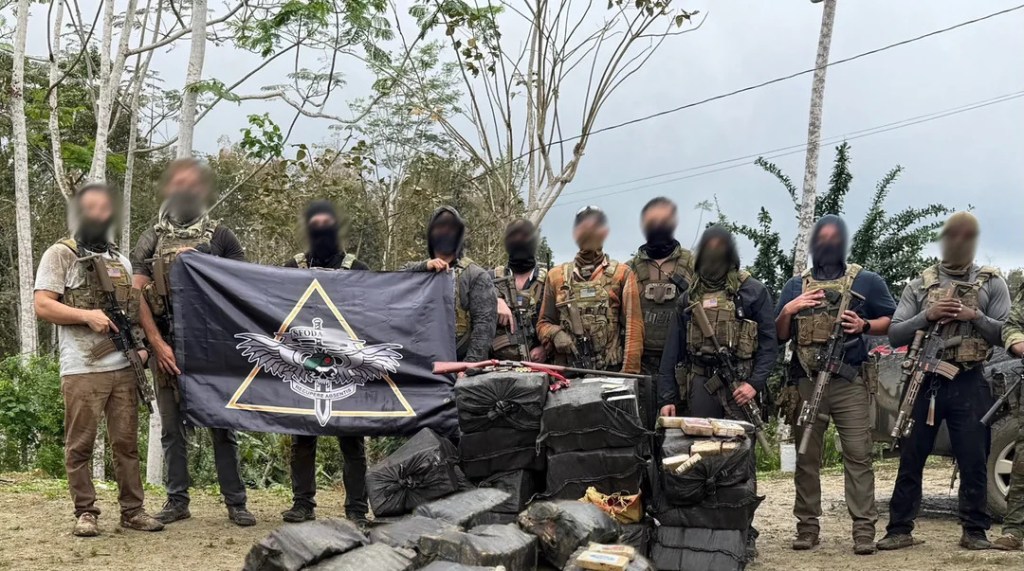

(The unit is known to operate within the Andean Ridge countries (Colombia, Ecuador, Venezuela, Peru, Bolivia) to combat drug trafficking and associated violence)
VIOLENCE AND HUMAN SECURITY TRENDS
6.1 Homicide Escalation Curve (National Level)
- Pre-crisis baseline (pre-2019): ~6–7 per 100,000
- Peak escalation (2023): ~45 per 100,000
- Sustained high volatility (2024–2026): ~35–45 range (approx. plateau phase)
Interpretation:
- Violence is not linear escalation
- Ecuador exhibits post-spike stabilization at the extreme violence equilibrium
6.2 Drivers of Violence
Primary drivers include:
- Fragmentation of cartel leadership structures
- Prison-based operational command systems
- Competition for port logistics (Guayaquil corridor dominance)
- Foreign cartel integration pressure
- State security overextension
OPERATIONAL GEOGRAPHY
Primary High-Intensity Zones:
- Guayaquil metropolitan corridor (port logistics hub)
- Coastal Esmeraldas region (cross-border trafficking node)
- Prison complexes functioning as command centers
- Northern Colombian border adjacency zones
TREND ANALYSIS (2026–2028 OUTLOOK)
Scenario 1 — Fragmented Narco-Stabilization (MOST LIKELY)
- Continued multipolar cartel competition
- Persistent homicide plateau
- No single dominant cartel emerges
- State maintains a reactive containment posture
Scenario 2 — Cartel Consolidation (MEDIUM PROBABILITY)
- One actor (likely Los Lobos or allied bloc) achieves dominance
- Reduction in inter-gang violence
- Increased cartel governance efficiency
Scenario 3 — Regionalized Collapse (LOW–MEDIUM PROBABILITY)
- Expansion of violence into the Colombian border regions
- Increased foreign intervention footprint
- Partial loss of state monopoly in coastal provinces
ANALYTICAL CONCLUSION
Ecuador is currently best characterized as a:
Fragmented narco-insurgency environment with hybrid criminal-state competition dynamics
It does not fully meet the definition of a failed state, but it exhibits:
- Partial territorial governance loss
- Parallel prison-state command structures
- Externalized cartel supply chain control
- Increasing foreign kinetic involvement
Without sustained institutional reform and prison-system stabilization, Ecuador is likely to remain locked in a high-intensity, low-control security equilibrium through the late 2020s.
 The Collective
Leave a comment