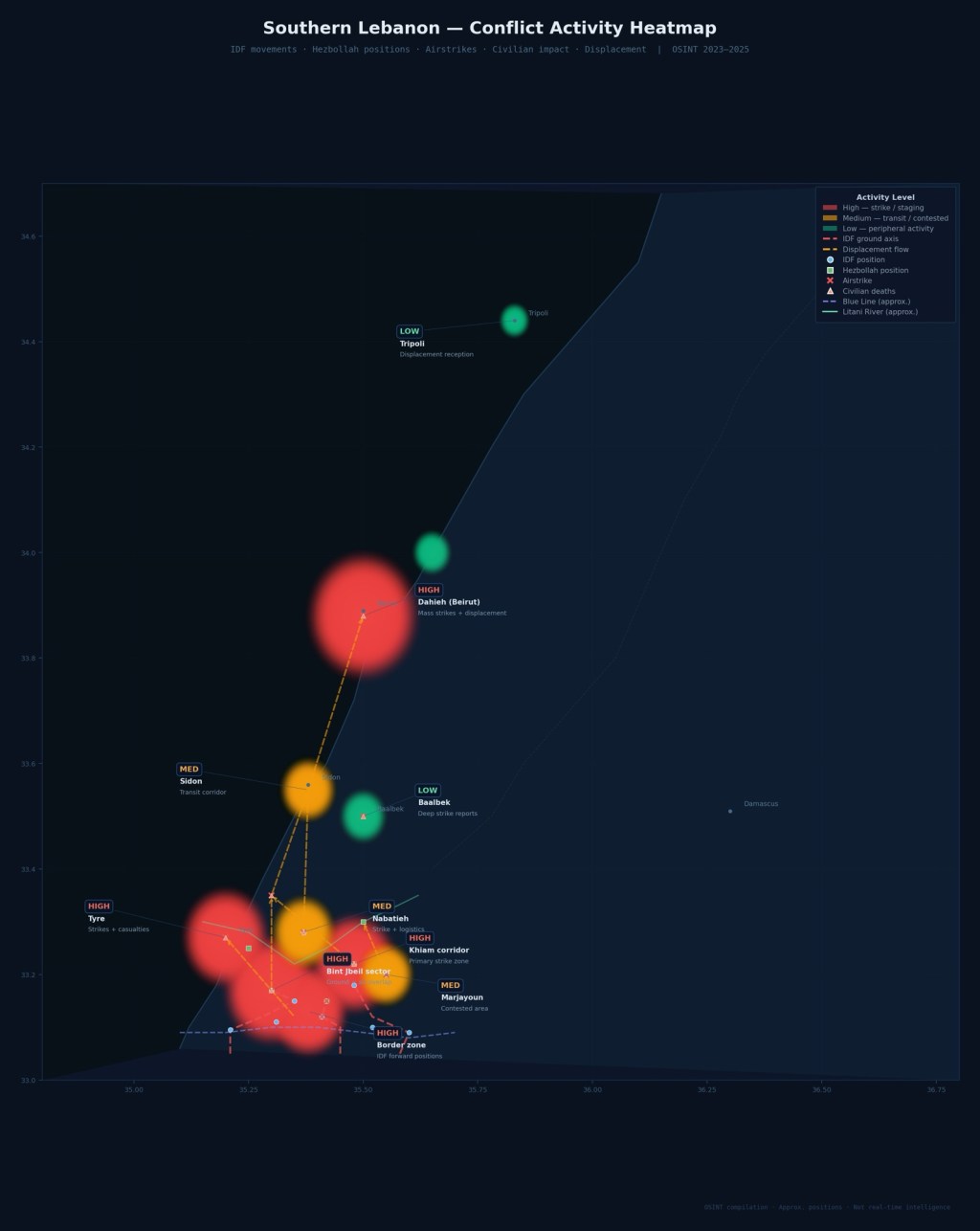
Date: 7 April 2026
Operational Synopsis
- Area of Conflict: Southern Lebanon, primarily areas south of the Litani River.
- Goal: Israel has shifted from tactical strikes to establishing a security buffer zone, aiming to disrupt Hezbollah’s capabilities and shield northern Israel.
- Primary Forces Involved: Israeli Defense Forces (IDF) mechanized divisions, air force, and artillery units; Hezbollah’s decentralized militant units.
- Recent Escalation: Ground operations inside southern Lebanon have intensified since early March 2026, including mechanized incursions and targeted strikes.
Actors & Capabilities
Actor
Capabilities
Recent Actions
Israel (IDF)
Mechanized infantry, drones, artillery, and precision airstrikes
Expanded ground incursion south of Litani; established new defensive line; targeted Hezbollah command/logistics nodes
Hezbollah
Rocket/missile arsenals, anti-tank units, local networks
Engaged IDF forces in southern Lebanon; launched retaliatory attacks; maintained insurgent activity despite losses
UN Peacekeepers
Limited enforcement & monitoring
Some casualties reported; preliminary UN investigation indicates both sides likely responsible.
Tactical & Operational Highlights
Ground Operations: Israeli forces are pushing several kilometers into Lebanon, targeting weapons sites, command centers, and anti-tank positions.
Air & Artillery: Strikes on Hezbollah logistics hubs near Beirut and Baalbek; continuous surveillance and interdiction of rocket launch sites.
Defensive Lines: IDF claims to have reached a desired internal buffer line, securing northern approaches.
Civilian Impact & BDA Summary
- Civilian Casualties: >1,500 deaths reported; 3,500+ injuries in southern urban centers.
- Displacement: ~1 in 5 Lebanese citizens (~20% of the 5.9M population) displaced by Israeli strikes, per Al Jazeera.
- High-Risk Areas: Jnah, Bir Hasan, Chiyah, Ghoneiry, Burj al-Barajneh, Haret Hreik, Hazmieh.
- Humanitarian Effects: Overwhelmed hospitals, disrupted aid delivery, and damage to schools and residential infrastructure.
Analyst Note:
The pattern of civilian displacement and damage in southern Lebanon is a direct mirror of the occupation dynamics seen in Gaza and the West Bank. Despite Mossad’s intelligence capabilities, continued civilian harm indicates challenges in “precision targeting” and should raise questions for the UN and other organizations about operational effectiveness against known Hezbollah operatives.
Strategic & Diplomatic Implications
- Israeli expansion into Lebanon risks a protracted counter-insurgency, increasing long-term casualties and material costs.
- Regional escalation could draw in additional actors in the Iran–Israel proxy conflict; recent Iranian logistical and advisory support to Hezbollah demonstrates Tehran’s strategic influence.
- Israel’s operations in Lebanon, coupled with continued pressure on Iranian-backed militias in Syria and potential maritime interdiction, suggest a broader objective aligned with the speculative Greater Israel project.
- International scrutiny over civilian harm and peacekeeper casualties may shape future operational constraints.
Connections to Greater Israel:
The ongoing Israel–Lebanon conflict is intertwined with Israel’s broader regional posture:
- Operations target Hezbollah’s infrastructure, indirectly countering Iranian influence in Lebanon and Syria.
- Israeli advances create conditions favorable for potential territorial consolidation and strategic depth in the north, consistent with conceptual Greater Israel ambitions.
Potential Next Targets:
- Southern Syria (particularly Daraa and Quneitra provinces) to disrupt Iranian and Hezbollah supply lines.
- Western Iraq (border regions) to limit Iranian militia operations.
- Maritime chokepoints (Lebanese and Syrian coast) to interdict Iranian arms shipments.
Reasoning: These areas represent critical nodes in Iran’s regional network supporting Hezbollah and other proxy forces; targeting them could enhance Israeli security buffers and strategic depth.
Likelihood of Greater Israel Project Completion:
- Based on current operational trends, regional dynamics, and international constraints, a fully realized Greater Israel scenario is low probability (~15–20%). Achievable elements, such as limited buffer zones and control over key corridors, are more plausible (~50–60%).
Assessment & Outlook
- Short-Term: Israel consolidating buffer zones; Hezbollah remains resilient; localized clashes and civilian displacement continue.
- Medium-Term: Potential for prolonged conflict, with repeated high-risk operations in densely populated areas.
- Under-Reported Elements: Shift to territorial control, peacekeeper casualties, high civilian displacement, widening internal Lebanese political fractures, and indirect confrontation with Iranian proxies.
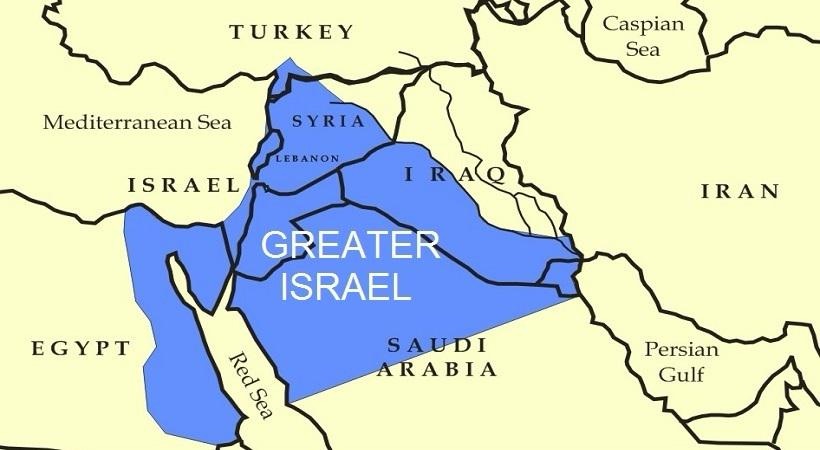
(The map generally encompasses the state of Israel along with Palestine, Jordan, Lebanon, and parts of Syria, Iraq, Egypt, and Saudi Arabia)
Analyst Summary: Civilian Impact & Operational Concerns – Lebanon & Regional Context 2026
The ongoing escalation in the Middle East, particularly in Iran and southern Lebanon, indicates a convergence of Israel’s tactical operations with broader strategic objectives. Israel’s actions in densely populated southern Lebanese districts, including Jnah, Bir Hasan, Chiyah, Ghoneiry, Burj al-Barajneh, Haret Hreik, and Hazmieh, have displaced approximately 1 in 5 Lebanese citizens (~20% of the 5.9 million population), per Al Jazeera reports.
This level of displacement underscores heightened risks to civilian populations and challenges in operational precision. Despite Mossad’s intelligence capabilities, the continued rise in civilian casualties raises questions regarding the effectiveness of targeting known Hezbollah operatives and the ability to mitigate collateral damage.
The pattern mirrors prior Israeli operations in Gaza and the West Bank, suggesting potential for a prolonged occupation scenario in southern Lebanon. Furthermore, the conflict’s proximity to Iranian-backed networks amplifies regional strategic concerns, linking the Lebanon theater to broader Iran–Israel tensions. This intersection of local operations and regional power projection highlights both humanitarian vulnerabilities and the potential pursuit of objectives aligned with the speculative Greater Israel project, although full realization remains unlikely.
References – Key Sources
- Al Jazeera (2026, April 2) – Israeli strikes kill 7 in southern Lebanon, Hezbollah targets ground troops
Link - AA News (2026, March 2026) – Israel sends more troops to southern Lebanon to expand ground offensive
Link - Reuters (2026, April 7) – Preliminary UN probe blames Israel and likely Hezbollah for peacekeeper deaths
Link - AP News (2026, April) – Lebanon buries a Christian official killed in an Israeli strike
Link - Foundation for Defense of Democracies (FDD) (2026, April 3) – Israeli goals in Lebanon war shift from imminently disarming Hezbollah to reestablishing the South Lebanon security zone
Link - WSJ (Wall Street Journal) (2026, April) – Israeli Military Says It Reached Desired Defensive Line Inside Lebanon
Link - Al Jazeera (2026, February 26) – What is Greater Israel, and how popular is it among Israelis? Link
 The Collective
Leave a comment