Executive Summary
Open-source aviation data indicates significant disruption and militarization of airspace across Iran and surrounding regions following coordinated U.S. and Israeli operations.
Flight tracking data shows:
- Near-total civilian airspace evacuation
- Increased military air activity (tankers, ISR, transport aircraft)
- Rerouting patterns consistent with active combat operations
These indicators strongly suggest ongoing kinetic operations supported by sustained aerial logistics and ISR coverage.
Confidence Level: High
Area of Interest (AOI)
- Primary: Iran
- Secondary: Iraq, Persian Gulf, Israel
Aerial Refueling Patterns (Critical Insight)
- On ADS-B Exchange:
- Tanker aircraft (KC-135, KC-46) orbiting in:
- Eastern Mediterranean
- Persian Gulf
- Loitering patterns = refueling tracks
- Tanker aircraft (KC-135, KC-46) orbiting in:
Why this matters:
- Tankers = force multiplier
- You don’t see fighter jets but you see what supports them
- ADS-Bs or Transponders go dark over LLBG in Tel Aviv which suggest all support aircraft are leaving from
Assessment:
Sustained tanker presence = ongoing strike capability and extended sortie duration
Analytic Assessment
The convergence of:
- Airspace closure
- Tanker orbits
- Strategic bomber positioning
Indicates a coordinated, multi-domain air campaign conducted by the United States and Israel against Iran.
Military aviation patterns confirm:
- Sustained strike operations
- Extended operational range via aerial refueling
Indicators & Warnings (I&W)
Watch for:
- Surge in tanker aircraft → incoming strike wave
- Increased ISR orbit density → target development phase
- Sudden airspace closures (NOTAMs) → imminent operations
- Civilian rerouting spikes → escalation indicator
NOTAMS From 04 Apr 2026 17:03 UTC (Tehran FIR)
A0739/26 NOTAMR A0736/26
Q) OIIX/QAFXX/E/000/999/
A) OIIX B) 2604041706 C) 2604120830 EST
E) CAUTION TO ALL FLIGHTS, AREA OF CONFLICT MAY BE EXTENDED OVER
HIGH SEAS WITHIN TEHRAN FIR IN PERSIAN GULF AND OMAN SEA
AS THE RESULT OF SECURITY REASON
Forecast (Short-Term)
- High Probability: Continued precision strikes on Iranian infrastructure and or Ground evasion
- Moderate Probability: Expansion into regional proxy targets
- Low Probability: Full-scale air campaign with sustained saturation bombing
Final Assessment
Flight tracking data from ADS-B Exchange and Flightradar24 provides strong evidence of active aerial warfare dynamics in the Iran theater.
The observable aviation patterns—particularly tanker operations and ISR coverage—serve as reliable proxies for otherwise classified military activity, confirming a sustained and coordinated air campaign.
Overall Confidence: High
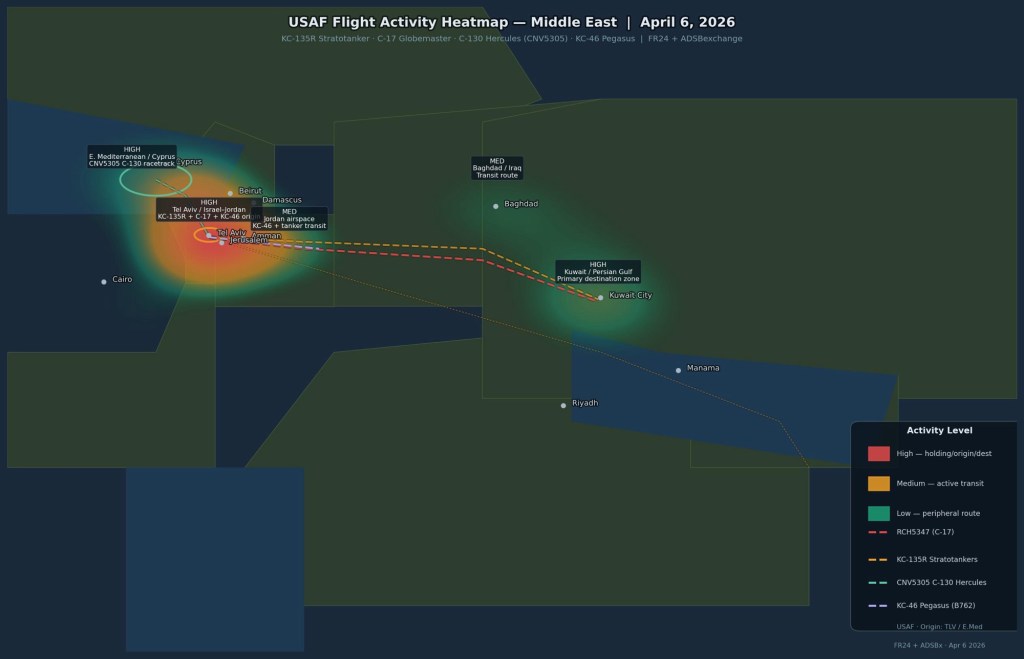
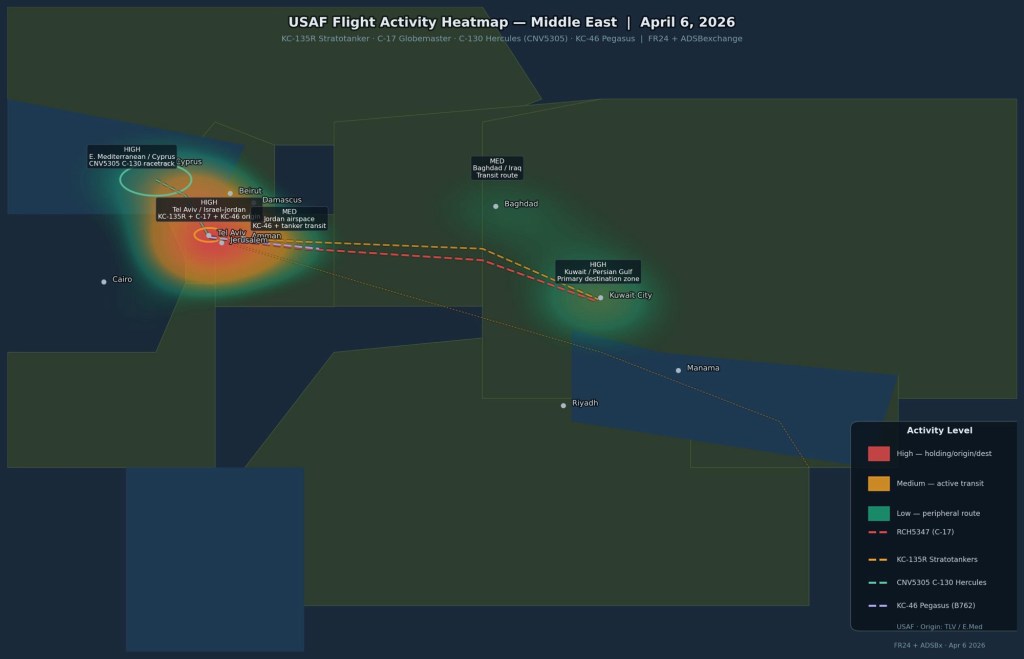
High activity (red) — Tel Aviv / Israel–Jordan border: This is the densest zone. Multiple KC-135R Stratotankers (registrations 57-1483, 62-3578, 59-1469) were all logged departing Tel Aviv, with at least one aircraft in a visible holding/racetrack pattern over the area. RCH5347 (C-17) also originated here.
High activity (red) — Kuwait / Persian Gulf: The primary destination zone. RCH5347 was tracked heading directly there, and at least one tanker (63-8036) was on a southward arc toward the Gulf.
Medium activity (amber) — Jordan airspace and Iraqi corridor (Baghdad): All aircraft transited this zone, making it a consistent throughput corridor. The KC-135R at 19,000–21,975 ft over southern Jordan is clearly visible in two screenshots.
Low activity (green) — Eastern Iraq / Zagros approach and Sinai corridor: Peripheral to the main mission tracks but used by some aircraft on wider routing.
Pattern assessment: The combination of multiple KC-135R tankers (which are aerial refueling aircraft) departing Tel Aviv simultaneously — ranked #1 and #2 worldwide on Flightradar24 — alongside a C-17 logistics flight heading to Kuwait, suggests significant USAF operational tempo in the region on this date.
Battle Damage & Casualty Assessment (BDCA)
Reported Loss of Life
- Initial reports indicate:
- 175 people including many children were reported killed in a U.S. strike on a school (Shajarah Tayyebeh elementary) strikes were targeted by using anthropic location use to be military barracks in the past
- at least 15 service member deaths and over 520 wounded
UPDATED NUMBER OF WOUNDED as of 7:25pm cst
An Iranian Shahed-136 drone strike on Ali Al Salem Air Base in Kuwait has resulted in 15 American service-members being wounded. The majority of the 15 have returned to duty.
With 380+ American troops being wounded in Operation Epic Fury, the majority have suffered TBIs but have returned to duty.
According to Pentagon data, the wounded from the various branches are as follows:
– 247+ US Army soldiers
– 63+ US Navy sailors
– 36+ US Airmen
– 19+ US Marines
Casualty figures remain unconfirmed, with estimates ranging from 20–75 fatalities across multiple strike locations. Independent verification is limited due to restricted access and information control.
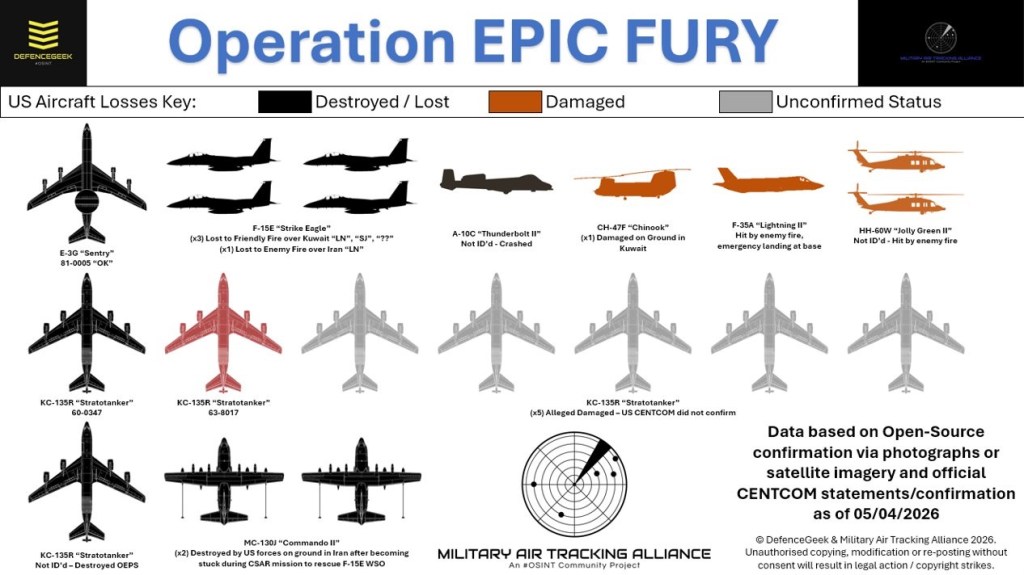
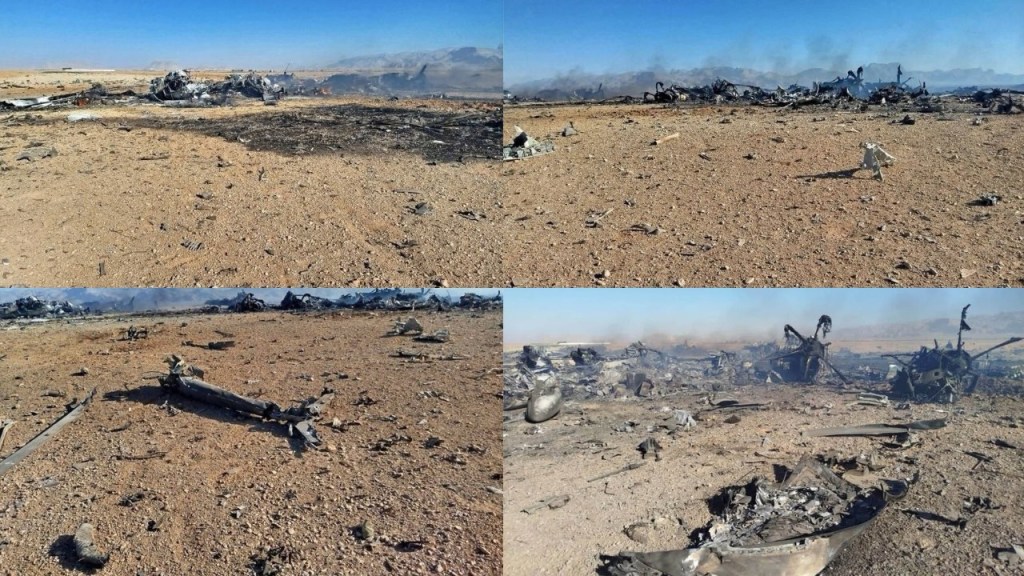
Battle Damage & Asset Loss Assessment (BDCA) — Updated
Aircraft Damaged / Destroyed
Platform
Status / Notes
Estimated Loss / Impact
Source
E-3 AWACS
Severely damaged by an Iranian drone at Prince Sultan Airbase (Mar 27); fleet partially retired
~63–71% deployed in Epic Fury; only ~50% mission capable in 2024; limited operational availability due to retirement
AA News, Atlantic Council
MQ-9 Reaper
Rotating orbits over Iranian airspace; 12 lost during Epic Fury
12 losses + prior 10% of fleet lost since 2023; estimated cost $192–$678M; fleet reduction to 140 may be impacted
AA News, Atlantic Council
KC-135 / KC-46 Tankers
Damaged or destroyed ~12 refuelers
33% of mission capable tankers supporting Epic Fury; critical for sustained sorties
AA News, Atlantic Council
Other Combat Aircraft
Includes F-35, F-15E, MC-130J, UH-60M, A-10
Total US aircraft lost estimated 17–25; financial impact $2.9–4.8B in first month
AA News, Atlantic Council
Substack
- Losses significantly impact sortie generation, ISR persistence, and strike endurance
- MQ-9 and AWACS losses reduce air surveillance coverage, increasing reliance on other ISR assets
- Tanker losses constrain long-range strike capability
- Financial impact and attrition highlight cost-intensive nature of the campaign
Aircraft attrition during Operation Epic Fury has degraded US operational capacity in multiple domains. Losses include MQ-9 Reapers, AWACS, tankers, and a range of fighter and transport platforms, with an estimated financial cost of $2.9–4.8B in the first month. While sortie generation continues, sustained ISR coverage and long-range strike endurance are likely constrained, increasing the reliance on remaining operational assets. Mapping these losses alongside active flights demonstrates the direct operational impact of Iranian defensive measures and ongoing attrition.
Sources:
- Institute for the Study of War
- The independent
- Sources via X (OSINT Defender, OSINT Technical, DefenceGeek)
- BBC
- Al Jazeera
- New York Time
 The Collective
Leave a comment